Tuesday, December 28, 2010

Zero expectations for predictable weather

©

As I write this it’s -50ÂșC in Yakutsk, Siberia. And that’s without any wind chill. In case you don’t know, Yakutsk is the only dot on the map for several hundred-thousand square miles in the far northeast of the Asian continent—where the temperature is the coldest on the planet.

Here at home we’ve had what can only be called chronic rain for several months. In fact, over the last four months the rain days have exactly equaled the rain-free days. This, of course, went over the top with the rain-induced flash flooding mid-month, which was so bad on December 13th that Environment Canada couldn’t collect the day’s precipitation stats.

It seems impossible to form a clear pattern of our weather, this, despite all the modern satellite technology we throw at tracking it. Call it the unpredictability factor. And that unpredictability messes up our ability to take issues like climate change or global warming seriously. We just can’t get a sense of the big picture on a personal level.

I get the same feeling looking back over the past year. While the real economy seems to be flatlining, the stock markets have risen dramatically, almost doubling from the crash two years ago. The big banks and investment houses are paying out huge bonuses, and the wealthy are getting wealthier, even though ordinary people in the States are still losing their homes to foreclosures and the unemployment rate has plateaued at near record levels.

Then there’s politics. On one hand Barack Obama has escalated the war in Afghanistan, while on the other he managed to get the START nuclear arms reduction treaty with Russia through the Senate in a major peacekeeping move.

Fouling up the big picture even more is the Julian Assange–WikiLeaks controversy, which may have been the biggest news story of the year. In a classic twist of the news, the story morphed into the Assange story rather than the actual leaks, which most people don’t seem to remember or even particularly care about. They do, however, seem to care about Mr. Assange’s use of condoms, or whether he’s a responsible journalist. (To be clear, he’s not a responsible journalist; in fact, he’s not a journalist at all. He’s an information technology activist. He admirably leaves the journalism to journalists.)

And then, of course, there’s the local scene. But what to say? That the Liberals crashed and burned and the Conservatives took over? Or that the Atlanticade motorcycle event came and went in one year?

Well kudos to the Conservatives. And the Atlanticade experience is not unique. Victoria, BC, just dropped its hugely popular Tall Ships Festival that attracted more than 32,000 paying visitors this year. The event apparently generated between $6- and $8-million for city businesses but the organizers just couldn’t come up with the $1.2-million cost needed to host the event in 2011. C’est la vie.

On the personal front, my experience with all the characters involved with Ministers Island tourism attraction was most entertaining, though decidedly unproductive. This project, like everything else this year, was a bit unbalanced and unsettled. Unfortunately, getting everyone on the same page with the same mission was impossible.

It all comes down to how things fit together—or not. A book I’m reading came to the rescue in terms of personal fit. The author talks about great economies and great places to live and mentions U of T professor, Richard Florida, who theorizes that the healthiest communities are the ones with the most accommodating environment for “creatives.” He includes Boulder, Austin, San Francisco, Madison, Wisconsin and few others in this category, most of them university towns with vibrant after-hours entertainment.

What you learn is that these cities have been engineered for success. Take, for example, Kalamazoo, Michigan. Like most cities in the U.S. Rust Belt, it experienced a rapid economic decline as industrial jobs were shipped overseas. But Kalamazoo’s civic leaders took action to attract new young families. Thanks to a number of wealthy local donors, they put together a huge endowment fund to pay the full Michigan university tuition for any student who attends K through 12 in Kalamazoo. Well, guess what? It’s working. The first 860 students have just graduated from university this year. And Kalamazoo is the envy of struggling towns everywhere.

Since arriving on the East Coast, I’ve been suggesting that we build these kinds of creative-minded, forward-thinking towns. This blog started out as, and still is, development-focused with that goal in mind. But I don’t quite think it’s worked. Perhaps that's what comes from trying to be overly innovative in conservative small town cultures. So as the New Year arrives, I think I’ll revise my resolutions—and my expectations. In 2011 maybe I’ll try to…

1. Accept the unpredictable.
2. Stop offering advice.
3. Avoid taking the lead.
4. Experience life.
5. Enjoy all kinds of weather.
6. Find more creative friends.
7. Talk to my kids.
8. Do stuff I love.

Because, as the cliché goes: life is short. The world is a very wonderful place, filled with opportunity and hope, and we should all aim to make the most of it, to explore as much of it as we can.

And there I go offering advice again. Damn. Well, I still have a few days left until the New Year…

Tuesday, December 21, 2010

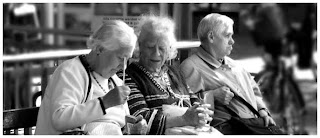
Your choice: take care of infants now or later

©

Maybe it’s because my birthday’s coming up. Or maybe it’s ‘Shock of Gray,’ the book I’m reading. Or maybe I can’t resist problems that can’t be solved. I’m talking about aging.

The front cover of Shock of Gray identifies its target: “the aging of the world’s population and how it pits young against old, child against parent, worker against boss, company against rival and nation against nation.” Well, that sounds daunting.

How daunting is it? Simply put, as the world’s population urbanizes and develops, fertility and birth rates fall. In Europe the trend is clear. Fertility rates have dropped as low as 1.3 children per couple, which is well below the replacement rate of about 2.1 children per couple.

Spaniards and Italians in particular fear their lines may be going extinct, and both countries rely heavily on immigration to keep their societies operational. Rising immigrant populations can be seen all across Europe, including Spanish-speaking South Americans, Moroccans, Africans, Middle Easterners, Pakistanis and so forth. One quote calls this a “demographic neutron bomb,” and another pictures the grand architecture of Europe inhabited by foreigners.

It’s not so much different here in Canada. We have the highest ratio of immigrants to residents of any G8 country—and we’re doing it to maintain a one percent annual population growth to keep our economy on the rails. Most of those immigrants go to central or western Canada.

When it comes to immigration, New Brunswick lags behind the rest of Canada. That’s a concern, since this province has the second lowest fertility rate in Canada at 1.5. The prospect of finding the workers we’ll need was one of the topics mentioned at the recent Future New Brunswick Summit.

But this is not a new scenario for New Brunswick. Throughout its history it has faced the prospect of out-migration—and periodic in-migration as happened in the 1970s. But the province’s population has plateaued just as it’s aging dramatically.

So what does an aging population mean, exactly? Here are a few factors:

1. Fewer workers, more retirees
2. Fewer children, fewer schools
3. Spiraling health-related costs
4. Need for small, warm housing units
5. Need for alternative transportation
6. Need for seniors’ services
7. Fewer tax revenues
8. Growing seniors’ poverty
9. A more risk-adverse culture
10. More ethnic immigrants to assimilate
11. Changing spending patterns
12. “Age-ism,” crimes against the aged.

And we’re not alone in our concerns. The effects (and causes) are global. The global economy is bringing a Western quality of life to the developing world, and as it does birth rates are falling there, too. At the same time, a massive global migration is underway, redistributing young workers across the developed world.

Once those workers and their young families arrive, they adopt our way of life, including our low fertility rates, and in so doing, join our aging populations. And, ironically, their mass exodus leaves only aging people back home. So places such as Equador and Peru now face the same aging demographic challenges that we are.

According to Shock of Gray author Ted Fishman, caregivers in Spain are symptomatic of global trends. These caregivers, often from Spanish-speaking countries, are usually females, who themselves are in their mid-50s. They take care of all the sordid tasks attached to aging such as wiping poopy bottoms and changing diapers as they take the place of urban sons and daughters who are too busy to look after their aging parents.

But for the more affluent among us, graceful aging is a self-obsession. Massive amounts of money are taken out of local economies and set aside in investments and savings to support future needs. Adopting healthy lifestyles becomes the focus, including fitness, healthy eating and vitamin therapy. Apparently, the “winner” is the one who dies the oldest—in the best physical shape.

Entire industries have sprouted up. Electronics companies connect the elderly to emergency care. Assisted living and seniors’ retirement facilities are a growth business. The pharmaceutical and cosmetic industries deeply into the demographic.

In our race to defy death we’re creating an aging civilization. Globally, there will be literally millions of people living beyond the age of 100. Over 12.5 percent of our population here in Canada (and New Brunswick) is now over the age of 65, which will increase dramatically as the century progresses.

Meanwhile, we’re running out of young people. And not just here, everywhere.

When we consider that just a hundred years ago a good life expectancy might be 65 years, this is a dramatic cultural shift. Both youth and age were valued in our past. Today those values are being stretched. Instead of taking care of newborn infants, we’re more often taking care of nonagenarian infants. And barring euthanasia, that presents some real problems.

To quote one Alfredo Bregni of the famous McKinsey & Co. consulting firm, “The future might not belong to whoever has the largest market or is the best positioned in terms of process technology or production skills. More simply, the future will belong to whoever thinks long term.”

Odd as it sounds, any long term future depends on people actually having kids.

Tuesday, December 14, 2010

Viewing ourselves as a Third World economy

©

There’s a cool map on the Natural Resources Canada website. It’s a Quality of Life map that lets you to zoom in on economic, social and environmental indicators—right down to the local level. And if you live in pretty (and affluent) St. Andrews or Chamcook, New Brunswick, the map could make you feel a bit complacent, life here is good.

And complacent we are. Flipping to Page 2 of the local weekend paper, I read about some guy who boosted a couple of drill batteries so he could get some work. He has a history of petty theft, already done time in the pen, is in methadone treatment and is now headed back to jail. Another guy, banned for life from driving, was sentenced for stealing a car and drinking and driving. Another chose to go to jail for five days rather than pay a $350 fine for marijuana possession. And then there was a guy who got slapped with a year-long court order to keep him away from his wife. Just another week in small-town-Canada-by-the-sea I thought.

Surely petty crime doesn’t make us a Third World county. But unemployment might. And one of the biggest challenges for many unemployed workers in the region is simply getting a ride to work. This kind of frustration fosters a general malaise among the disaffected workers, and contributes to family violence, petty crime and substance abuse—which is arguably just self-medication to keep the user relatively sane. Longer term, this turns into a social pattern, which then reappears on Page 2 with the same family names showing up over again and again. The pattern becomes multi-generational.

According a regional labour force study conducted here in 2007, the number of our young people without a high school education is almost 30 percent higher than the provincial average—and more than a quarter of our young men between the ages of 20 and 34 haven’t completed high school. Now, connect that to unemployment, petty crime and substance abuse and you’re starting to get the bigger picture.

Coincidentally, I started re-reading Jeffrey Sachs’ excellent book, The End of Poverty, this week. Toward the back of the book he has a chapter on making the investments needed to end poverty, and lists six specific resources that require attention:

1. Human capital
2. Business capital
3. Infrastructure
4. Natural capital
5. Public institutional capital
6. Knowledge capital.


To these I would add another:

7. Production capital.

Sachs makes a very compelling case for wise public investment in these resources, because, he notes, once the resources of an economy are properly primed, collective momentum will lift both the individual worker and the general economy above the threshold of collapse. I've added production capital to his list, because we seem to be losing our grip on the ability to produce real goods, which most Third World countries have not.

Sachs shows that by lessening the disparity between the “haves” and the “have-nots” and creating a more equal society, we all gain.

Canada, as a whole, is doing pretty well in the equity department. For example, our Canadian educational system was recently rated #2 in the world, just after Finland. A CBC Radio interview pointed out that one of the main reasons for this success is the equal opportunity provided to the student by the Canadian system. To quote the Conference Board of Canada, “Canada has one of the highest rates of high-school and college completion in the world. While Canadians are at school, they become well educated, for the most part, in core subjects like mathematics, reading, and science.”

If that’s the case, our local backwater has some catching up to do. And in terms of adult literacy, so does Canada as it turns out, which is lagging behind in that department.

Basic skills affect economic success. Here in our county, as of 2007 when the economy was still strong, there were twice as many unemployed women as in the rest of the province, with nearly 20 percent out of work. Almost 15 percent of males were unemployed and the combined unemployment rate was just over 17 percent. And at the same time we’re importing workers. How can this be possible?

It’s possible because we don’t seem to have an economic development framework in place that actually changes the status quo in our work environment. In fact, our county is a stagnant culture—and is slowly losing population, dropping 1.7% between 2001 and 2006. And this is a trend that could happen anywhere in the country where an investment in key resources declines over time—or where natural resources become exhausted.

So what’s the answer? As Sachs says, there isn’t a single answer. Clearly it’s a matter of investing in our resources first. To my mind his Third World framework is excellent—and can be applied anywhere. By enhancing shared resources, developing new skills and creating educational equity, we can empower our local people to begin innovating for themselves.

But first we’d have to abandon the ideas that a) change is a threat, b) we’re the best place in the world and c) only the privileged few get to direct the show. And, in fact, if you check out the Quality of Life map, you may find that not everything is quite so rosy where you live, either.

Simply put, we need to challenge the status quo. It’s time to adopt a progressive Third World strategy and ditch the “keep everyone in line” Third World attitude.

Message to Prime Minister Stephen Harper? What we need is a lot more hope and a little less punishment.

So. Who’s going to lead the next parade?

Wednesday, December 8, 2010

On the front lines of a 40-year information war

©

After a month of rain we now have…snow. School is cancelled and the kids are at home as I write this and not much else is happening.

For some social contact I turn to the news. Ironically, the top news story last week was… the news. In a "thermonuclear news event," WikiLeaks dropped the first batch of over 250,000 secret documents.

We got an hour-long dose of the controversy while driving home from Christmas shopping and listening to CBC Radio’s Cross Country Checkup. A recurring theme among callers seemed to be frustration with a general lack of government transparency, and the growing trend toward government control of all information—not just the secret kind.

But what is WikiLeaks, and why should we care? WikiLeaks is a web-based organization that collects political information and redistributes it to the media and the public. As such the organization views itself as an ethical public service organization. And as far as I can tell it’s true. No one at WikiLeaks is getting rich. To the contrary, they’re constantly under threat of reprisals from international governments and organizations.

Including one from Stephen Harper’s former chief-of-staff and adviser, Tom Flanagan, who in a CBC interview last week, quipped, "Well, I think Assange [the head of WikiLeaks] should be assassinated, actually. I think Obama should put out a contract and maybe use a drone or something.”

Most people don’t think Flanagan’s comment is exactly funny. After all, this man, Flanagan, has just one degree of separation from the prime minister. Obviously, his opinions matter. And just who is this dude?

Flanagan was born and educated in the United States. As a student he was especially enamoured of Austrians Hayek and Voegelin, both of whom are considered seminal influences on free market philosophy and economic conservatism. He went on to teach at the University of Calgary, and subsequently got involved with Preston Manning’s Alliance Party, and later with Stephen Harper, eventually managing his 2004 Conservative campaign. Flanagan is pretty much the poster boy for American-style conservatism, and a senior fellow at Canada’s leading right wing think-tank, the Fraser Institute.

This connection between U.S. conservatism and its Canadian counterpart is significant. Much of Canada’s new conservative movement comes from the west, which has strong financial ties to the energy sector south of the border, especially in Texas. And that’s Bush country. It’s no coincidence that Alberta and Saskatchewan are primary suppliers of fossil fuel to the U.S. and also share similar political ideologies. America needs our hydrocarbons and needs Canadian politicians who get it.

So if our Canadian political philosophy is beginning to mirror the U.S., what does that mean for Canadians? For one, I expect we will continue to support their war efforts in places like Afghanistan and an ever-tightening control on public information, which has been a hallmark of the Harper government. This new approach to media control has its roots in the negative coverage of the Vietnam War, Watergate and the Iran hostage affair—resulting in an increased tightening up and spinning of information to fit government leaders’ objectives. This media hijacking has fuelled a decade of fear in the United States, facilitated the removal civil liberties through the Patriot Act, “embedded” reporters into the military and diluted reporting on the actual effects of war. It’s been a massive effort to “dumb down” the American—and Canadian public. Which takes us back to the media.

The media is not what it was 40 years ago. The ownership of today’s media has aggregated into fewer hands, most of them highly conservative, such as Australian media mogul Rupert Murdock, owner of the rabidly right-wing Fox television network, and a man never reluctant to reshape the news to fit his own philosophy.

Here in Canada, David Thomson, owner of global media giant Thomson Reuters, is the wealthiest Canadian—by far—with an estimated net worth over $20 billion. Closer to home, Canada’s third wealthiest family, the Irvings, own most of the print media in New Brunswick. This puts enormous power to influence public policy into the hands of the few.

But wait. There’s still the Internet, right? The place where anyone can still say anything? Not for long. Last week the Obama Administration put a bill before Congress that would allow the president to take executive control of the U.S. Internet, including shutting it down entirely for up to four months in case of an “emergency.” And in fact, nothing we do on the Internet is private and secure anyway. Every e-mail can be combed by the government for “subversive” content. Which is what makes WikiLeaks so important. This is the last major battle for a free and open media.

And how’s it going? Not well. On top of the coincidental international hunt for Assange to arrest him on a rape charge in Sweden [he surrendered himself to authorities yesterday], the WikiLeaks site, ironically, has been removed from that bastion of free speech, Google (remember Google’s split with China over censorship?).

Assange and his team are our last media heroes and deserve our support. Go to www.wikileaks.sh to check it out for yourself. Or visit www.collateralmurder.com to get a snapshot of the real war in Iraq.

Then we might all join Tom Flanagan’s mentor, Hayek, in his noble goal: that the “coercion of some by others is reduced as much as is possible in society.” Amen.

* For more on Tom Flanagan and his polarizing effect on Canadian politics go to http://www.walrusmagazine.com/articles/the-man-behind-stephen-harper-tom-flanagan/