Monday, May 28, 2012

Dude, lighten up, you’re getting too heavy


OK, I KNOW THAT a few people think my writing is a bit heavy, and they don’t mean obese. Sure, I write about some serious stuff.

But I get it. As if I’m going to save the world in 850 words or less. Case in point. As I write this column, as in right now, my editor is chatting with me online about the new Employment Insurance (EI) legislation coming into effect.

His first take is, he supports the new changes. Why? Because a lot of people take advantage of the system when they’re able to take other work. And it’s true. Many people do. But like a lot of issues, it’s rather complicated. Here’s a sample of our current discussion over the last five minutes:

Editor: I have to, for at least the third time this year, admit that I agree with the Harper government. That's painful.

Me: What did they do right this time?

Ed: EI reforms. Just crunched some numbers. Mainly in reaction to the “it's my money” claims from the downtrodden worker and union boss. Generally speaking, the total employer/employee contributions for a year, for someone making $46k per year, are returned in four weeks less a day.

Me: As a single issue I could agree. But this is woven into the fabric of an economic discussion about Canada today and its future. What are we doing as a country, becoming a new resource powerhouse like Australia? Becoming a part of the North American Union concept, in which labour is leveled across the continent to Mexican-American standards? And what about a social well-being economy? Or an innovation economy? Or an environmental economy? This instrumentalism with systems like EI beggars the imagination. Because it comes from beggared imaginations. That is not to condone the cheating by the bottom. But what if there truly ARE no jobs? Think Campobello or McAdam or Grand Manan. As I mentioned the other night, perhaps we should just move them all to the tar sands project and be done with it.

Ed: And that's what my editorial is trying to point out. EI is needed by the waitress earning $10/hour working for some crap tourist-driven restaurant. But not the lobster fisher or roughneck pulling $55k over four, six, eight months of work.

Me: Well, that's the thing, I guess. But are the lobster workers part of a corporation or are they independent contractors who have to buy and maintain their own equipment? And what sort of benefit plans do they have, or retirement plans, or savings plans? Big corps have been offloading to small contractors for decades. There's even a term for it: “externalizing costs.” It's also pretty much what they do with the environment. Take for free (or as little as possible) and clean up only what they're forced to clean up. Now index this with the Harper government's gutting of environmental regulation and you start to get into the bigger picture.

Ed: If I'm self-employed, I can't collect EI. Been that way for ages. If I'm self-employed, it's up to me to look after my future. That's also nothing new.  I think the EI reforms bite at Calvin Helin's [The Economic Dependency Trap] pointed declaration: the surest way to kill a man is to pay him to do nothing. And believe me, I've seen more than a few bilk the system.

Me: But what if all self-employment ties back into a corporate-dominated economy run by big banks and other giants? The contractors simply become indentured servants to bank debt and seasonal contracts. And a whole lot of additional government regulation.

Ed: Me, I think the big issue isn't corporatization so much as its twisted driving force: the push to continue growth, even though it is inherently illogical. I don't know enough about Keynsian/Malthusean whatever-the-heck-it-is to be more intelligently critical, but we have to shift from a growth-based economic model into a sustainable model. And the whole idea of having other people work to make you rich—known as the stock market—is inherently flawed. Geez, I guess that makes me a leftie, donnit?

No, I don’t think my editor is a leftie or a righty; he’s just trying to make sense of a world that refuses to make sense.

Even the simple things get complicated and heavy. This weekend my editor and his wife lost their orange cat, Winston. He got run over by a car. Winston was a kind of gentleman charmer, and it seemed irrational for him to wander off and get killed in that way.

And I’d rather not think about Winston and get all heavy about it. But when I do, I think about the pets that I’ve lost. Like a favourite dog who accidentally got into some Warfarin behind a grocery store. It was a death meant for the rats feeding in the garbage bin out back. Not nice.

In fact, there’s a lot of stuff that’s not nice. And sure, we should work to make the world a better place. But first we need to love the world. And there’s plenty of poetry in both sunshine and the rain.

Thursday, May 24, 2012

Quebec: sound of the corporate pyramid collapsing

HUFF POST (draft)

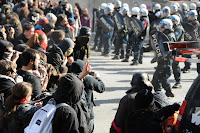
IT'S A PROBLEM when 250,000 protesters hit the streets of a Canadian city. But who's to blame? And what's the problem? The problem seems clear: Quebec students don't want heavy increases in tuition. And the certainly don't want their protests to be declared illegal by the Charest government.

So whose fault is this? Some blame the students who, they think, should man up like students elsewhere in the country and pay their "fair" share. Others think it's Charest and his heavy handed government foisting a conservative (in-Liberal-clothing) pay-as-you-play agenda on the poor students and those who are least able to afford it.

The actual problem is rather more complicated, and one that tends to get buried under opinion pieces about Conrad Black or his take on Facebook, as if it really mattered. The root problem is the growing interrelationship of academia and business.

University education, over the past five decades, has evolved from a science and liberal arts focus into a Babelized smorgasbord of offerings, most designed for and dovetailed to the needs of industry. Programs such as public health management and carbon capture (not that there's anything wrong with these studies) have superceded the more traditional fields of study such as engineering and literature.

The origins of this convergence of universities and industry are a bit chicken-and-egg. The outcome, however, is plain. Colleges and universities now operate on a corporate managerial platform and collectively act as a corporate feeder system for research and human resources.

As profit-focused entities with higher levels of management to support, teaching costs must be held in check, researchers must be supported, fundraising departments managed and courses developed and culled according to the current (and to a far lesser extent, future) demands of industry.

In other words, universities are now just corporations. Harvard, Oxford, LSE, ENA, Waterloo and McGill are brand names in most respects no different from Apple, Mercedes and McDonald's; companies which also do a fair amount of internal research, education, fundraising and HR.

Students know this whole deal intimately. They're the ones racking up enormous debt (unless they're lucky enough to have parents who will pay) to learn skills that will very likely be obsolete within a decade, and leave them unschooled in the critical and imaginative proficiencies they will require as they take over this increasingly compromised world.

Having worked to market and fundraise for academic institutions and having a daughter currently in university pretty much tells the tale. Few university management, faculty or students deny that this new corporate-academic emperor has no clothes, and most openly acknowledge it. Student newspapers are peppered with WTF articles about the university disconnect from real education.

Ironically, it was the feel-good involvement with fundraising that probably started the decline. Once the universities started putting their fundraising campaigns into high gear, their development philosophies inevitably merged with those of their donors. Donors were only too willing to educate the poor academics about business principles and management practices and the value of developing industry-friendly programs. Until the entire academic process became harnessed to economics rather than higher learning.

But the system thrives, not only because of a lack of organizational creativity to challenge it, but from the conditioned acceptance that this is just the way it all works. And the students are taught from birth they must both conform and compete to get ahead.

Well, until now, until Quebec. Clearly the protest is now about more than just a rise in tuition. On top of the growing student awareness of the whole mess: the crippling student debt, lack of jobs after graduation and the prospect of a collapsing economic future; now there's Charest's cute "back to school" Bill 78, though it's not working. In spite of massive fines of up to $125,000 for organizing peaceful protests of more than 50 people without giving police eight hours notice, students are taking to the streets en masse.

So now what? Well, that's a big question. The universities, like the arts, operate as parasites at the very top of the inverted socio-economic pyramid. And that pyramid is collapsing, at least here in North America and Europe.

Once production and the service sectors were offshored and we transitioned into financial distribution economy the die was cast. Without a strong production base and the innovation to feed it with new ideas, economies simply disintegrate under the weight of the massive management superstructure.

This top-heaviness is as true in the private sector as it is in the public sector, and while austerity measures in both sectors actively target the front line workers, the management class, especially at the senior levels, continues to grow and flourish. And unless graduating students have family connections, they're starting out at the bottom of this pyramid with a load of personal debt piled directly on top of them.

While that might be fine for employers looking for highly incentivized and compliant employees, it certainly doesn't make for a finer society.

Taking to the streets is an immediate reaction. The ultimate action will require shifting our paradigms from profit taking to social wellbeing. Unfortunately, the university leaders who should be leading this reeducation revolution seem to be entirely missing in action.

Tuesday, May 22, 2012

Hiding behind rules: protecting power not people


On the local front:

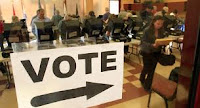
WE WENT DOWN to the polling station to vote in the municipal election on Monday morning. It wasn't even noon and already there were long lineups.

Yes, local election fever had swept through our small New Brunswick town. And it had infected us, too. My wife found a mayoralty candidate she liked and volunteered to help his campaign.
   
Three days before the end of the campaign my wife worried that her guy didn't have enough exposure, so she went shopping for paint and Bristol board, and the family pitched in making bright, florescent signs. Then she posted the signs around town, some on telephone poles and others on supporters' front lawns.

In the evening, she took the kids out to take a look. Twenty minutes later the door opened and I heard, "The signs are all gone." I thought they were kidding, but no. Of the 29 signs they'd put up, 22 were gone. By the next morning only two were left--and those went down by noon.

I suspected that there was some by-law about posting signs on telephone poles. But if that were the case, why weren't old yard sale signs also torn down? And why were lawn signs also removed?

The answer was obvious. Someone wanted them gone. It turned out it was the retiring mayor, who was supporting another candidate, and he was using the "rules" to support his position. Of course, the unspoken message seemed clear: "Zero-tolerance if you're not with me! No lively participation allowed."

But what about common decency? Or citizen enthusiasm, or free speech?

To his credit the local Town manager told the mayor that the signs would only be up for a day, and that there was no need to have Town staff take them down. So the mayor took it upon himself to have the signs removed, in other words, have them stolen.

I guess if the rules on signs were really important to our past mayor, all yard sale signs should be regularly torn down, along with posters for fundraising spaghetti dinners, and even realtors' signs planted on Town-owned easements. But of course it wasn't the signs; it was the message on the signs.

And in the end? Most of the residents saw the colourful signs go up, and then go down. It was the talk of the town. The signs came down in the pouring rain and on Mother's Day no less. And the next day my wife's candidate won.


Meanwhile on the home front:

In the middle of the campaign our daughter took her second driving test. She was nervous and it was nerve-wracking for me, too. I couldn't find our insurance slip so on the way I stopped to get a new one and we barely made the appointment on time.

Predictably, the tester asked for her paperwork, and after looking it over, noticed that my wife hadn't signed the car ownership. And that was that. He shut down the test and mumbled about making time for us later if we wanted to come back.

We drove home (a maddeningly unnecessary 25 minutes each way) got the paper signed and drove back. He was on his lunch. So we waited. When he showed up, he said he could take her right after his first appointment.

His first victim was a young woman, also anxious, who arrived with her mother. After she passed, her mother told us that this was their fifth try. Hmm. The girl didn't appear to have a learning disability. My daughter told me later that one of her friends had taken the test eight times. I could see that this was a whole new standard of testing.

It was my daughter's turn and off they went. When she returned, I knew. Tears didn't flow until we were back in the car. Apparently, she hadn't parked well enough in the test space. On the retry she forgot to use her turn signal (this was an off-street test site) and he failed her. Plus there was also some confusion around a tricky yield sign. But on the positive side, he'd told her with a smile, she definitely knew how to drive, and he liked her car. Well, gosh.

I resigned myself to the fact that she could have done better. But my cynical side tells me that this is a very convenient way to keep income rolling into the Service New Brunswick office to keep staff gainfully employed.

It is also painfully obvious—given the numbers of absolutely dreadful drivers I encounter here every day—that the new zero-tolerance approach to testing is virtually useless. But somehow the rigid enforcement of the rules is now paramount.

On the world front:

These things are more than a local aberration. There's the growing trend of unchecked authority hiding behind new rules—rules that will allow almost limitless power over ordinary citizens.

But there are a few rays of hope on the horizon.

Today, journalist Chris Hedges, Cornell West and others on their team are celebrating their victory in court against the Obama administration. U.S. Federal Judge Katherine Forrest just struck down the most controversial portions of the National Defense Authorization Act that would have allowed the U.S. military the right to indefinitely detain and hold U.S. citizens anywhere in the world, including at home, without charge or trial. Forrest ruled that the Act appeared to violate the First and Fifth Amendments and was therefore unconstitutional.

How does this connect to stealing signs and punishing driver's tests? Just that it's all a part of an overarching pattern. We're living in times of growing intolerance and diminishing trust. And if civility and trust disappear, what do we have left?

I somehow doubt the crushing hand of authority ever contributed to a kinder, gentler society.

Monday, May 14, 2012

Elections, dead bicycles, peeling paint, long grass


LOCAL

Entropy wins. According to my handy computer dictionary entropy is a: “lack of order or predictability; gradual decline into disorder.” And here it is again, every spring.

As I was doing the first yard cleanup of the year I about every system winding down, including political systems, which, I guess, is why we have elections in the first place.

And to that end we went out this morning to vote. I was surprised by the attendance. There were long lineups, and I overheard one gentleman joke, “I guess this election must be important.” Well, let me get back to that.

First, the yard work. Our not-so-old lawnmower died last year. Maybe it was bad gas. Whenever it decided to start, the engine would surge and stall. I was done with repair shops; fixing it would take half of what a new one would cost. So, predictably, we have a new one.

This one I got on sale. Our oldest boy made short work of the long grass and wildly dandelions in the front yard. And I did the back yard, which was more like an obstacle course of toys and bikes around a trampoline rather than an actual lawn.

The mowing then led to the bikes, which I soon discovered were in a sad state. Our two older boys had managed to break the brakes on both of their new rides, so I went to work. After solving that, I decided to give my own bike to the oldest and to give his to the youngest. Call it a family-wide ride readjustment.

By the time I’d finished, the boys and their mom had their old scooter out and we’re trying to swap out its wheels with a leftover mini-bike. I was invited me to help and went inside for lunch while I grappled with the old parts. True confession? I hate mechanical work, it makes me grumpy.

Once past the greasy wheel bearings and hammering the reluctant back wheel in place, I spray painted the rusty handlebars. The paint sun-dried in seconds and the kids, happily fed, came out to wrangle their new ride.

They left me tuning up the rest of the fleet, mostly lubricating and tightening cables. I discovered that couple of the bikes, after a few seasons outside, were way past their best-before date. Entropy again.

With the lawn mowed and the bikes fixed, I took a looks at the house. And it was showing the effects of winter, too, but nothing a paint scraper, bit of paint and a brush wouldn’t fix.

While the man-made stuff was showing the effects, the growing stuff around the house is a wonder of anti-entropy. The bushes and shrubs are in fresh leaf and the huge cherry tree in the back yard is in full bloom. There was even a tiny black humming bird buzzing through the scene. It was as if nature didn’t need my attention at all. Which is true, of course.

OK. So all of this home development work leads my thinking back to local development and the voting in the town elections, which are still going on as I write. And back to the implied question posed by the guy at the polling station: is this election important?

Like my yard work, the key issue seems to revolve around the relationship between entropy and development. On the one hand, there are a lot of new candidates coming on board promoting the need for change. On the other, there are some old faces saying, well, I don’t know what. Maybe the importance of remaining the same.

One of the younger candidates in our town has a slogan: “Help me help you.” I don’t know exactly how she intends to help me (she didn’t say) other than she’s eager, willing to listen and wants a fair system. Another candidate running for mayor wants to bring in new development. And still another candidate, a former mayor, declined answering questions for the region’s major daily newspaper. It’s all very interesting. And unclear, as these things tend to be. We vote with emotion and not logic, apparently.

As for me, there’s some entropy at work here, too. My head is tired of tilting at windmills, trying to figure out what might make the world a better place. There’s a realization that’s been coming for a long time. I believe, with some good evidence, that we’ve moved from being a society of individuals capable of imagining our future, to a corporate collective that manages events and challenges as they come, minute by minute. Any remaining visions as such, are now small and manageable. The big, imaginative thoughts have been banished to the land of the impossible. Or sent off to those we think can afford them.

So the real entropy is the loss of the imaginative frontier. Sure, it still exists, but in more rarified corporately funded fields such as bioengineering or nano-engineering. For the rest of us, better to forget it, clean up the yard and take a vacation. As the wheel turns, spring and summer will be over soon enough.

Friday, May 11, 2012

First the environment. Now we're overharvesting humans

HUFF POST (draft)

I’m not talking about the actual human harvesting going on: the illegal harvesting of body organs, legal and illegal stem cell research, human trafficking, industrial labour camps. It’s something more subtle and pervasive than that.

It started small, as most revelations do: As I visited websites I noticed the same ads popping up and they seemed to be following me. It was clear that I was being pushed toward certain advertisers.

This was nothing new. One of the goals of the advertising agency I worked for in the late 1980s was to work with our clients to put a $40-a-month needle in our customers' arms. This was easy in the early days of cell phones when we gave away free phones to get people to sign three-year airtime contracts, and which soon turned into a multi-million dollar business.

Today the entire credit-financing model works on that principle. Cars are "purchased" for $120 a week. T.V. and Internet entertainment packages are offered for "low" and not-so-low monthly fees. And services have replaced products as the new corporate cash cows.

The trend is about to become even more sophisticated. On CBC's Under the Influence radio program, host Terry O'Reilly talks about the development of "hyper-targeting," the business of electronically fingerprinting online customers.

The goal is to data mine our personal online histories to place customized pieces of advertising directly in front of us just as we're about to make a purchase. Say if we're filling out the option sheet to get a price on a Ford Focus, competitor GM will place an ad on the sidebar offering a 10 per cent discount on a similarly optioned Chevy Cruze.

O'Reilly tells us that this is just the beginning. Credit card companies already track our online behaviour to predict our future credit-worthiness. If we check our card balances in the wee hours of the morning too often, the card companies might flag our accounts as indicating financial stress or marital problems.

So we are being groomed even before we’re harvested (connected to debt machines) by these companies.

This is a new level of intrusiveness now includes the new national security legislation emerging in the U.S. and Canada, legislation that may ultimately give government agencies access all our online activities and personal information stored with our Internet service providers.

The technology is now in place for both kinds of spying, and O'Reilly talks about the rise of a new class of algorithmic data geeks managing these new systems.

Surprisingly, some people are fine with these new incursions on our privacy. "If you've got nothing to hide, you've got nothing to fear," their thinking goes. Others of us take exception to these new developments but feel powerless to stop their advance.

But what's driving this advance?

After the development of agriculture and the rise of feudalism, we entered a new age of technology during the Industrial Revolution. This freed the landowners from harvesting their lands, cut the farmers free from their ties to the soil, and bonded a new class of dreadfully under-rewarded workers (think of Dickens’ child workers slaving in the poor houses) directly to production. This, of course, led to all kinds of social distortion, including the rise of socialism, communism, two world wars and now, unfettered capitalism. John Ralston Saul writes eloquently about this in his 1995 book, The Unconscious Civilization.

The Digital Revolution has now liberated the owners from the ownership of any means of production, which is now done offshore by independent, invisible supply companies in former ‘Third World’ countries. This means that not only cash is digital and thus borderless, so is labour.
           
But first, a word from our corporate sponsor: money. Today, lending institutions create digital money out of thin air. So every time these banks write a loan, there are little to no actual funds to back it up. The banks simply “declare” they have the money, and transfer the appropriate number of digits into another bank account. No cash has changed hands.

To say that this is a big temptation to manipulate the system is an understatement. It’s no surprise that subprime mortgages were bundled together and sold as commodities on the investment market, and then market bets were placed on the futures of those bundles until, well, the whole thing collapsed and millions of ordinary people were thrown out of their homes.

To offset the threat of financial collapse, governments around the world bailed out the commercial banks and investment companies while homeowners went broke. Here in Canada our government printed out $114 billion dollars to tide over four of our large banks through the crisis.

The overall result has been the creation of a new generation of indentured debt slaves, enslaved to debt not based on real money (human energy) at all, but to electronic ciphers that generate perpetual interest payments to the masters of these financial systems, and government dedicated to protecting the interests of the banks over the interests of its citizens.

So how did this happen? Corporations, technology, centralization and capitalism have welded together an unholy alliance designed to harvest, that is, asset- and cash-strip, everything in its collective path. Profit has become the guiding force of every human activity. Profit, not social well-being or working for a healthier planet.

The entire system is now a vast bloodsucking network pumping profits from every region of the human collective body to the centralized head office at the top. Those in charge of driving those profits, the executives, managers and administrators, now make up 50 per cent of the population.

Of course, in a healthy human body there is always the other half of the circulatory system, the arterial network that drives blood through the lungs and delivers re-oxygenated blood throughout the body to refresh and renew the entire system. But in our society, we are destroying that arterial system, our publicly-owned social services network, so in fact, we are now living in a diseased society.

We witnessed the first symptoms of this in the environmental destruction caused by industrialization. We are now witnessing the controlled leeching of profits, that is the harvesting of human energy, from every human being on the planet, through an intentionally-designed, centralized, technologically-driven organism.

That was my revelation. But I had to travel to a meeting in Chicago to have it reinforced. It was the trip that did it. I, along with several thousand other passengers, was herded like livestock through miles of yellow cordoned, serpentine walkways through international airports to have my papers checked, my baggage X-rayed and my body scanned. (I was even singled out for a new, random full-body scan--or a full-body grope; my choice).

I watched as my fellow travellers, virtually all of us peaceful, law-abiding citizens, acquiesced to this indignity. Rather than putting an armed guard on every plane, if it really were terrorism we feared, we we’ve been conned into investing trillions of dollars to train ourselves to accept the basest submission.

The humiliation our system is imposing humanity is now global. Not to mention the new class of militarized, psychopathic bullies we've created and are now enduring. I can only conclude that the effect is not for security but for the mindless control of the subjugated masses to continue the harvest.

So, what can we do to staunch the relentless bleeding of our fellow human beings? The answer? We have to put a stop to this suicidal process of putting profits above everything else. That means rebuilding a conscience-driven government disconnected from corporate interests. And if we think about it, that's not really so hard to do.

Because our living planet, in all of its marvellous diversity, desperately needs time to heal.

Monday, May 7, 2012

Who needs local culture in a brave new world?

LOCAL

The big guy sitting beside me was from Alberta. We were flying to Toronto on the red-eye, him on his way home, me to a meeting. We talked about the future of the west, which he thought would be golden for at least the rest of the century.

I wasn’t so sure, and asked him about the low provincial royalties on oil and the increasing foreign ownership of the oil sands. Unsurprisingly, he didn’t have answers. But apparently foreign ownership is having some effect on the people of Fort McMurray, Alberta, as I learned from a friend living out west. She e-mailed me a link with this bit of news:

“At 11:30 this morning (May 3), the faculty of the Visual and Performing Arts programs at Keyano College were rounded up and given 15 minutes to clear their offices, then escorted from the premises by security. They were not met by the administration and informed that their programs and jobs had been cut. They were not given pink slips. They were not even notified by email that this was their last day at work. They were escorted out by security like common criminals.”

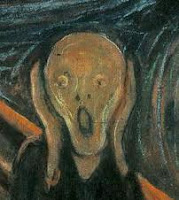
Did the irony of Munch's The Scream selling for $120 million the day before the shutdown escape anyone? Sure, I understand how undervalued art has been in this country. And for a brief moment in the late 60s we even had a few of our own superstar artists.

But the drift away from the arts in education has been unrelenting, and it corresponds directly with the rise of global corporations and a profit-driven centralized management culture. This new culture doesn’t value innovation, creativity or outspoken honesty, which form the basis of the arts. In fact, the new culture requires quite the opposite. And the managers of this evolution vote with their arts dollars, or lack thereof.

There’s more to it, of course. Like every other province, Alberta is cutting back—yes, cutting back—even in the middle of its oil boom. The province, operating under the assumption that the foreign oil investors will disappear if oil royalties are too high, has kept them low, and hasn’t contributed significantly to its Heritage Fund since the late 1980s. This year the Alberta government is predicting an $886 million deficit and doesn’t plan to either raise taxes or oil royalties for at least three years.

So, short on cash, the province is doing what governments everywhere do: it’s cutting frills, like the arts. This is no big deal, I guess, to workers in Fort McMurray, where annual wages for tradespeople are well into six figures. They’ll still have their shiny new pickups and iPads even if their kids can’t get into a local arts program.

And in the bigger picture maybe none of this matters. Our executive class now has access to four millennia of collectible art. Our museums and art galleries are stuffed to overflowing with it. And those artists remaining are challenged to find new ways of seeing and saying things. Now, with everything having been discovered and said, the work of today’s artists may never find available gallery space anyway.

But there are other careers. Ah...or are there? It used to be that artists could go into other fields, like marketing. The advertising industry could be an extremely profitable creative environment, albeit ethically questionable, and those ads actually influenced most of the great art of the last half-century.

Yet even that’s disappearing. There won’t be much need for it as advertising turns into online data tracking. In something called algorithmic targeting, data trackers individually aim photos, discounts and product descriptions directly in our path just as we’re ready to purchase. You can check it out on Terry O'Reilly's radio show. So with no need for creative messages, it’s good-bye creative departments.

Coincidentally, on the same day that the Fort McMurray arts program was cancelled I was facilitating a workshop with some medical researchers. They’re facing the same problems—though in the initial stages—that artists have endured for decades. And the reason? Research is now seen as either too expensive or unrelated to direct profit streams.

The end game is aiming everything at profit and cutting the rest. As for the rest of us, we’re either a part of a reengineered society of passive managers, resource extractors, service sector workers, distributors and buyers. Or else we’re falling out the bottom of an emerging new class system with no bottom in sight.

So yes. This closure is significant. It’s one more symptom of privatizing and profitizing every aspect of our society. Meanwhile, we’re letting both our public sector and our environmental commons collapse.

And why might this be important to New Brunswickers? Well, some of us may be leaving for the boom in the west. Meanwhile, the rest of us staying behind can be sure that the government cuts are going to be much more severe here, because our government either won’t want to tax the corporately wealthy for fear they’ll leave, or because it’s already in bed (and sound asleep) with our corporations.

Sound familiar? Yes kids, you might want to put down that watercolour brush and grab a Skillsaw.