Friday, April 27, 2012

It's war on Suzuki and the environmentalists

HUFF POST (draft)

THE GAME is over. It’s now all-out war.

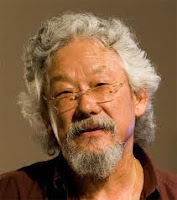
This week, David Suzuki and his foundation came under attack by the ironically named Ethical Oil group, a new American anti-environmental video has been making the rounds online, and the $500,000 Koch brothers contribution to Canada’s right-wing Fraser Institute made the news.

I don’t know which of these I find most disturbing. Or maybe it’s the combination of the three that we should find most disturbing. Because what we’re seeing is the politicizing and distortion of science. And frankly, we will need a clear scientific perspective if we’re to have any hope of keeping our complex support system going on the planet.

David Suzuki is a scientist. Though he has become a communicator and an activist, nevertheless, it is science that informs him and motivates him. It’s more than coincidental that Suzuki and his foundation have come under attack by the oil lobbyists just after the federal government accused the Canadian environmental movement taking money from and being under the influence of “foreign interests.”

Back in February, Brian Jean, a Conservative member representing Fort McMurray and the tar sands region of Alberta announced that he planned to table a private member’s bill aimed at outlawing foreign donations to Canadian environmentalist groups. For those who missed it, this is tied to the oil industry’s push to get federal approval to build the Northern Gateway pipeline from Alberta to the B.C. coast to export tar sands oil, the Conservative government’s support of the industry plan and the inevitable public and environmental push-back against the plan.

The Suzuki Foundation was caught in the cross-fire as pro-industry anti-environmentalists began to pressure the organization about its political advocacy activities. Responding to the pressure, Suzuki resigned from his foundation so he could “speak freely without fear.” But, one wonders, or at least I did, why should Suzuki have anything to fear?

The answer came a week later, when EthicalOil.org, with strong ties to their spiritual leader, Ezra Levant, and to the Conservative party, then hired a lawyer and drafted a 44-page letter to have the Suzuki Foundation’s charitable status revoked by Canada Revenue Agency (CRA) for allegedly violating the tax laws governing the amount of political advocacy the foundation is allowed to pursue under Canadian tax laws (10 per cent of its total work). Apparently there will be an investigation that should tie up the foundation for months or even years.

Well. That was a rather large cannon ball fired at the foundation’s hull; the first man overboard being Suzuki himself.

Ethical Oil, name clearly revealing its true function, was now attacking the ethics of others -- instead of those real but ever-so-irritating environmental issues. Issues such as the actual environmental impact of tar sands oil mining and the potential environmental risks of the proposed pipeline.

Meanwhile, in seeming lockstep with Ethical Oil, the Conservative government has fired up its own war machine on the environmental movement, giving the tax department a windfall of $8 million (this in a time when the CBC budget is being slashed) to enforce the rules on charities and not-for-profits. Yes. There seems to be good reason for Suzuki's choice of the word “fear.”

Fear was the weapon of choice once again in a slick but subversive little propaganda video I saw circulating on the net this week. It’s called “If I Wanted America to Fail.” The video opens with a headshot of a clean-cut young man who delivers a lyrically poetic rant about the evils of environmentalists and their support of “expensive energy” (alternatives such as wind and solar) and their opposition to sources cheap energy (read: fossil fuels), the oil companies and the American way of life. The video is being promoted as “going viral.”

Watching it as a career marketing person, I couldn't help feeling that this was right up there with outright political propaganda complete with misleading information and half-truths, just like most of the commercial advertising we see today.

The difference, of course, between this new “Fail” video and commercial advertising is the fact that the commercial audience knows that the companies are telling one side of the truth to sell products. The propaganda videos, on the other hand, don’t have that unspoken preface. The audience is encouraged to view them as “truth.” But what gives them away is their emotional appeal rather than the weight of real physical evidence.

What is most maddening is that the new anti-environmentalist approach has become a war on actual fact, a war in which everything is turned away from actual reality toward what the audience interprets is simply a war of conflicting opinion.

But the laws of physics, unfortunately, can’t be suspended to accommodate anyone who chooses to disbelieve the physical laws. Cigarettes do cause cancer. The world is not flat, whatever Thomas Friedman's sense of humour might say. The polar icecaps are melting. And fossil fuel is a non-renewable resource, spin it however we may.

The final news item was the Koch brothers’ donations to the Fraser Institute, which pretty much puts the cherry on it in my view. The donations were among the largest handed out by the oil billionaire brothers according to their U.S. records, though the donations were never made public by the Fraser Institute; it took the Vancouver Observer to do that.

For its part the Fraser Institute has been actively involved in influencing and shaping Canadian government policy for decades, while claiming to be “not political and non-partisan.” I guess it’s one of those suck-and-blow things. What is clear is the Fraser is anti-environmentalist. You can find gems on its website such as: “New video urges Canadians to ‘Question the Hype’ about global warming,” and “Sustainable water exports possible with reformed Canadian water policies,” and this classic, “New report details over-looked scientific evidence against simplistic climate alarmism.”

And it’s offering these anti-environmentalist materials to classroom teachers, so your kids can become anti-environmentalists—just as its Koch-funded American counterparts are doing in the U.S.

I don’t know about you, but I don’t think that the current concern among the vast majority of the world’s climate scientists about climate change is “alarmism.” I also don't think most Canadians want to start exporting their fresh water to the U.S. or the rest of the world for that matter, unless I’ve missed some significant new development. And I want my kids to learn how to love the environment, not hate the environmentalists who are trying to protect their future.

But the Fraser Institute, and the people who finance them to influence Canadian policies, certainly do want those things.

So what’s really happening? How can the average Canadian separate the real science from the BS? Or the bad opinion from the good?

The simple answer? It’s all about motivation. Just ask yourself who stands to gain the most cash and control of our natural resources from any government decision. And there’s your answer.

Hint: Somehow I don’t think we need to worry about Suzuki selling off our resources to foreigners for a profit—or for a lifetime seat in the Senate. Do you?

The good news in this declaration of war on the environmental groups is that the wealthy pro-industry forces, through their recent slam-dance tactics, have now openly acknowledged that these “tree-huggers” are highly effective at representing the public’s interests. The battles may have escalated but this war is far from over.

Monday, April 23, 2012

Nuclear dynamics of cultures and voting

LOCAL

It’s raining again. It feels like winter in Vancouver, except it’s spring along the Bay of Fundy.

As fate would have it, I’ve been reflecting about the news. Today I’ve read about the elections in Alberta and the rise of the Wildrose Party, a Canadian cabinet minister (Bev Oda) spending a thousands a day on limos and $665 a night at a tony London hotel, and an Ontario teacher railing against her former students for falsely accusing her of abuse.

Yesterday, I read that a pact was announced between the United States and Afghanistan to “protect” the war-torn country after the 2014 withdrawal deadline. And I read about American soldiers parading around and posing with the body parts of dead Afghan insurgents.

There is so much streaming through the news that we barely have the inclination to follow it all. But what about the major ongoing stories that we should be following? As in, say, Fukushima?

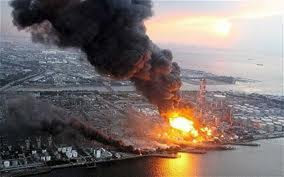
The rain brings this to mind. Scattered reports across the Internet suggest that Fukushima is still leaking significant amounts of radiation into the air and water. And unlike Chernobyl with one reactor meltdown, Fukushima had six units in total, four of which are seriously damaged. (Unit #4 may soon be a breaking news issue; see photo, follow link.)

A major part of the Fukushima story is the government fumbling, corruption and misinformation following the event, which I won’t get into here. But add to that the alarmist speculation that emerges as a direct result of unclear communications, and one sees a disaster of epic psychological proportions.

The story is still complex and unclear. I gather there are still cooling issues at the plant. A full meltdown through the concrete seems to have been averted. Some 1500 tonnes of contaminated water were to be jettisoned into the ocean. Meanwhile, the Japanese government has committed $13 billion to the cleanup, which will include the removal and disposal of 29 million cubic meters of earth from the area, the whole process taking an astonishing 40 years to complete.

The Japanese culture has a lot to do with the handling of the crisis. Perseverance, stonewalling, saving face, dignity and honour are old features of their society. These same qualities kept them fighting in World War II long past the possibility of winning, until Truman put a stop to it with the two nuclear bombs. Fukushima has been called, correctly I think, Japan’s third nuclear attack.

We, of course, have our own nuclear power station just up the highway. And like Fukushima it is located on a sensitive ocean coast and has had its own safety issues in the past. Without getting into whether our nuke plant is a good or bad idea, I wonder what its existence says about our culture and social values. And just what is our culture?

There are two leading cultures out here: the Loyalists and the Acadians. Both are surprisingly enduring and remarkably conservative. Here in southwestern New Brunswick the Loyalists are dominant.

Loyalists, by definition, are loyal to the British Crown. For example, the Protestant Loyalists in Ireland supported the British occupation of the island and opposed the formation of an Irish republic, and this opposition led to a sectarian violence that raged for decades. That aside, Loyalist behaviour in general supports the ruling authority, resists change and actively supports long-standing family connections, a governing hierarchy and an unwritten acceptance of a class system.

Unlike those rebellious republican neighbours (in Canada’s case to the south), Loyalists do not have a history of embracing truly open, democratic traditions.

So why am I telling you all this and what does it have to do with radioactive rain?

Because how we govern ourselves affects the very air we breathe and food we eat. Governance is the essence our life’s breath as a society, and a demonstration of our cultural and environmental values.

And there’s a local election coming up. So this is timely.

I want to talk to you new candidates. And you voters who should care. Candidates, no matter what ideas you may have going in, understand that cultures are self-replicating. The facts prove it. Even when entire management teams are replaced at a stroke, corporate culture is often left totally unaffected. Organizations have a memory and recidivism beyond any of the individuals involved.

What does that mean to you as a candidate? That there are three parts to your new job: insight, oversight and foresight. And that for too long in this part of the world, punishing oversight has been the main feature of government, and an abiding loyalty to the interests of the wealthy (for if they don’t do well, we may well lose our jobs and tax base, so the instinctive thinking goes).

Here’s my message to all candidates. As the old saying goes, you are only as good as the poorest among us. If you can get that straight and build a better community for them, with insight and foresight, you might have something to offer the rest of us who vote. Otherwise, you’re just more of the same old, same old, working for The Man.

If we look and listen carefully, we might all build something more than a pretense of democracy.

Closing Kingston pen with dark glasses on

HUFF POST

Public Safety Minister Vic Toews has just announced the permanent closure of the Kingston Penitentiary and the Leclerc Institution in Laval, QC. Apparently, both facilities are antiquated relics of a bygone era. Kingston, built in 1835, is one of the oldest, continuously operating prisons in the world.

I've never been to prison. But several years ago a realtor took us to look at a house located just across the road from one. "Not a problem," she said, "there are only a couple of escapes every year." That federal prison located in Dorchester, NB, is also an old facility, built in 1880. Once a notorious maximum security lock-up, it now handles all of Atlantic Canada's medium security offenders with an emphasis on psychiatric care and rehabilitation. There's a big farm attached to it to prove it. But the place still seems pretty rough. Just looking at it one gets the idea that Canada's prison infrastructure is a bit out of date.

As I read the news about Toews' announcement, I expected to read that there would be some new, high-tech Panopticon-style facility being built to replace the old prisons. But I was wrong. The prisoners are being merged with existing prison populations elsewhere. According to Toews, this is not a problem.

The good news is the government, or "we," will be saving $120 million a year, and most of the staff will be reassigned to other institutions. And we won't be spending any more money to build new prisons.

The bad news is the existing prisons are already running at over-capacity. Millhaven is 112 inmates over capacity and the max security complex in Saint-Anne-des-Plaines in Quebec is 217 inmates over its design. Closing Kingston today would result in nearly 100 more inmates over the Canadian prison system capacity. And there's talk that about 100 prison workers will lose their jobs.

The whole thing is a bit more complicated than that, of course. The Conservatives have committed to adding 2,700 new prisoner spaces to existing facilities over the next five years, which should alleviate some of the pressure.

And then there's the new "tough on crime" legislation introduced last year. Stats show that the increase in new inmates is lower than expected, and Toews states that, "Instead of attracting all sorts of new criminals into the system, we're just retaining the old ones." Hmm. That doesn't sound like progress.

Still, the prison population has grown from 13,300 two years ago to about 15,000 today. If that rate continues at the same pace (about 1,100 a year) due to new legislation and a tougher economy for those living on lower incomes, Toews' plan to add new spaces is going to be half as much as the system will actually need. Hello, more overcrowding.

I'm no prison expert, but I suspect that the short-term solution of packing more inmates into aging facilities is a recipe for long-term disaster.

A report by the Alberta John Howard Society in 1996 stated the same thing. It noted that Canada's prisons were already overcrowded with over 20 per cent of prisoners "double-bunking" in cells. The report cited the decision by Correctional Service of Canada (which was dealing with a total prison population of 12,400 at the time) to "more effectively deal with violent high-risk offenders, while examining alternatives to incarceration for low-risk offenders," which represents the most dangerous 18 per cent and lowest risk 17 per cent of the prison population.

And those alternatives are exactly the initiatives the current Conservative government is eliminating with its new tougher stance on crime as we begin to overfill our prisons with petty thieves and drug offenders—to teach them a lesson.

But what lesson will "we" be teaching? Today's prisons are dealing with epidemics of mental illness as social downloading has offloaded the mentally ill on the justice system. HIV/AIDS is an ongoing concern, especially in overcrowded and thus emotionally charged prison conditions. Not to mention the obvious, that every neophyte offender going in gets a thorough crash course in a life of professional crime and violence.

Race is another hidden aspect of these new, wrongheaded policies. Canada's prisons have a disproportionately large population of aboriginal inmates. But Toews and his fellow Conservatives, with dark glasses securely in place, are conveniently colour-blind now, as well.

As for Correctional Service of Canada, its reward for making those recommendations all those years ago with be a growing problem and a cut of $295 million over the next five years. I expect that this won't make for a more "efficient" department.

But wait. There is hope on the horizon. If the government system becomes too inefficient, we can privatize parts of it. Bad idea. It's not working too well in the U.S. where the private prison model requires high levels of incarceration to remain profitable. And it didn't work well here, either, when the new, five-year-old 1,200-inmate private super-prison at Penetanguishene was shut down in 2006. Rates of reoffending were higher, the health of prisoners was lower and the security was worse than in our old publicly-run institutions. End of that story.

So what should we be doing? We should be looking at our whole society first. World data (via Wilkinson and Pickett) show that more income-equal societies have lower rates of crime and incarceration. So the job starts with creating good jobs and shifting a proportionally greater share of taxes to the top income earners in Canada.

Second, we have to address mental health issues head on in this country which are now at unmanageable levels. Third, we need to reach out to our First Nations people, and bring them into the economic decision-making process of the country. Fourth, we need to invest in rethinking, redesigning and rebuilding a more enlightened prison system worthy of the 21st century.

And finally, we need to start redeveloping a sense of ourselves as forward-thinking, caring Canadians, with a common vision of our own future—beyond hauling non-renewable oil and minerals out of the ground (like some Third World country) and selling off them to the lowest bidders, along with the remnants of our Canadian-owned corporations.

It's time we told our politicians to take off the dark glasses. Those people we're tossing in our jails are our neighbours and fellow Canadians, not scum to be cleaned off the soles of our shoes.

It's been said before and I'll say it again: the American prison model isn't working for them, and it sure as hell won't work for us. And if you don't believe me, just ask Conrad Black.

Thursday, April 19, 2012

People want real answers. Not ribbon cutters

LOCAL

None of us has heard the actual plans for the Algonquin Hotel. We know that most of the hotel workers were laid off several weeks ago.

So what’s the deal? As a citizen of St. Andrews and of New Brunswick I was a co-owner of that hotel. Now it’s owned by Southwest Properties in Halifax. They put up $4 million as a retainer on the place, and we, the citizens of New Brunswick, lent them another $20 million.

Did our government put any restrictive covenants in place to protect our interests in this sweetheart deal? Do we get the first right to repurchase the hotel should the new owners decide to sell within a certain timeframe? Or a restriction on carving up and parting out the property to other developers? Or keeping the golf course in one piece? Or hiring and training locally?

The real question is, of course, why weren’t we told anything? We don’t even know anything about other bidders for the property.

Increasingly governments are behaving as if they’re secretly working for the economic interests of corporations rather than for their citizens. While corporations get invited to full disclosure on privatization deals, the public gets...nothing but silence. Before and after the deal.

There’s now a rumour floating around that New Brunswick’s ferries will be privatized, sold to the highest bidder. By now this has an unsurprising familiarity. It falls in line with the aborted sale of NB Power to Quebec, or the federal sale of the Atomic Energy Corporation Limited to SNC-Lavalin last year. Or the privatization of Petro-Canada. These were all significant investments by our government in Canadian infrastructure that the private sector was unwilling or unable to do.

Petro-Canada is a poster child example. Formed in 1975 to protect Canadian oil resources (from American exploitation) after the OPEC oil embargo and with a $1.5 billion federal cash injection plus the roll-in of government-owned Panarctic Oils and Syncrude, it quickly became a leader in Canadian business. During the late ’70s and ’80s it acquired Atlantic Richfield, Pacific Petroleum and Petrofina, and later the Canadian service station chains of British Petroleum and Gulf. By 1985 it was a dominant and highly successful energy company…owned by us. And by 1988 it sponsored the Calgary Winter Olympics.

By 1991, under Brian Mulroney, our control of the Crown corporation was gutted. The majority of the shares were sold (19 percent was kept by the government) and within months chunks of the business were being sold off, share prices dropped and staff was slashed from 11,000 to 5,000. The Canadian oil industry was now safely back in American hands. This was all depressingly similar to the Avro Arrow story two decades earlier.

Finally, the Liberal government under Chrétien put the remainder of the shares on the block in 2004. In 2009 Petro-Canada merged with Suncor, a subsidiary of the U.S. Sunoco corporation. The merger created Canada’s second largest company. Nice of us to help them along.

So where are we? And where are the people we elect to inform us and protect our interests? Simple answer: asleep. Here in our little county we have town councilors who’ve literally sat on council for over a decade. Unless we challenge our representatives we’re at the mercy of those who do challenge them: the special interests that want something for themselves or their corporations. We might start by clearing the slate by not electing any of the old, familiar names.

And then there are the global concerns, for which we have no answers. At this level most people just give up thinking about it. “Climate change? What can I do about it?” they ask and move on.

But there are answers. First, we need to educate ourselves about our current situation on the planet. To do that we need to separate the corporate misinformation from the real information. It’s no easy task. Second, we need to rethink the role of economics and government.

Economics (or money) is not what we think it is. It isn’t real. Resources are real. Human enterprise is real. But finance is an elaborate rigging of the game. We need to detach ourselves and our governments from corporate and financial rigging. That means holding our politicians accountable—to us. Third, we need to begin to act as if Earth’s resources are limited. That means being willing to challenge all of our assumptions. For example, that cars are a modern necessity, or that daily commuting and long distance tourism are a birthright. They are not.

In short, we need to start opening up discussions among ourselves about our own common future. And we have to start learning to work together (instead of competing for cash) to build better societies. Because business as usual will soon be impossible. And we can see the clear signs in front of us with rising fuel costs.

For my part I have to ask, what would my town look like without a tourism industry? Or without conventional cars and trucks? That reimagining process leads our thinking in entirely new directions. It may even keep us awake at nights. But at least we won’t be asleep as the future unfolds.

Monday, April 16, 2012

Are these warnings of Titanic proportions?

HUFF POST

It was a Facebook moment. A friend posted a link to some photos of modern downtown Detroit. Here were buildings of exquisite beauty, like the wonderfully ornate United Artists Theater, abandoned, vandalized and decaying. The title of the collection by photographers Marchand and Meffre was The Ruins of Detroit.

Eerily, the photos reminded me of the photos James Cameron took of the Titanic a few years ago. I was not alone in thinking this. A piece in the UK’s Guardian made the same comparison, and tells us that a third of Detroit’s 140 square mile area lies abandoned and derelict.

When we think of the Titanic that went down exactly a century ago this weekend, we think about the paradox between the engineering, wealth and craftsmanship that went into building her and the sinking and loss of life on her first trans-Atlantic run. It’s a mythic tale with dimensions so profound and numerous they don’t need explaining.

I think the great fascination with the Titanic has to do with the minds of the designers and owners: the popular idea that Titanic was above mere physical laws of nature, an industrial era version of the old Daedalus and Icarus tale.

With the 100th anniversary of the sinking this Sunday, the fascination shows no signs of abating. Old movies and documentaries are being dusted off, enhanced—think Titanic 3D—and reshown. There’s even a pop-out book with a cardboard Titanic model that I bought for my son.

But I also have a personal connection to the Titanic. Researchers from my old hometown, Thunder Bay, did some DNA work a decade ago to identify one of the unknown victims buried in Halifax. That turned into a whole story of itself, complete with protests about digging up the graves, the nearly total disappearance of DNA due to the decomposition of the bodies acidic soil and the misidentification of the “unknown boy” as Eino Panula which was later revised, identifying the victim as 19-month old Sidney Leslie Goodwin.

Ironically, while the molecular science was as infallible as the Titanic, it raised powerful memories to the surface. The young victim didn’t die alone. His father, Fred, 42, his mother Augusta, 43, and his siblings Lillian,16; Charles, 14; William, 11; Jessie, 10; and Harold, 9, all died. They were an Irish family on their way to Niagara where Fred had found work at the hydro generating station. They’d been booked on another steamer, but transferred to the Titanic when a coal strike kept the first ship tied up at dock. Bad luck all around.

Their story affected me. We have five kids roughly the same age and I have fears that the same turn of luck could affect any of us. It’s the unpredictable intersection between personal and world events.

And I can’t help comparing the Titanic to our world. The Titanic was a floating city on the ocean, with everything that means: a complex set of systems, management teams and routines working together to dominate a hostile environment while the passengers—some at least—travelled in sybaritic comfort.

Here on the Mothership we’re a highly engineered civilization floating in space. Our interwoven systems are far more complex and interdependent than any city, nation or empire in history. By nature we’re parasitic; we’ve had to be to survive, and today our complex civilization mines resources at an astonishingly voracious rate. The scale of our consumption is beyond any easy calculation, and the environmental impacts are simply incalculable. We can’t even seem to agree on the effects of CO2 we pump into the atmosphere—on the order of 20+ billion tonnes a year—but there must be some effect. The Arctic is still heating up, global temperatures keep rising.

I don’t want to get into reciting a list of environmental threats. None of us does. And so the whole idea of looking at ourselves as a whole becomes nearly impossible. A common reaction people have is “take the blue pill” and forget about it.

Conveniently, that means no one is at the helm of the Titanic. As the first global civilization we are too new at it to have any global system of governance, not that I’m advocating any kind of New World Order style one-world government. But what we have instead are what national governments pursuing what we euphemistically call “geostrategic interests” using a cobbled together collection of trade agreements based on economic benefits.

What gets left out, and I’ve seen behind that particular curtain, are the more profound strategic issues lurking beyond trade-economics such as regional development and energy, not to mention culture, human rights or the rest of what makes up a compassionate, future-oriented, globally-interdependent society.

But the biggest changes are happening at the personal level, on the deck of the Titantic. And it’s getting a bit crazy down here. David Suzuki even noted it a few weeks ago, in his blog post, “Is it Just Me, Or is the World Getting Nuttier?” Suzuki was talking about government nuttiness. The stuff I’m talking about is closer to the ground.

Like what’s on the online news feeds. My wife had insomnia last night and spent some time net surfing. So I woke up to a story about a kid jumping out a third storey window after shooting a cop in the face, and then showing up in court with his face swollen and smashed to a pulp by police. And another one, a video this time, about a gang of guys beating, robbing and stripping a drunk tourist in front of a bar in Baltimore while bystanders laughed and recorded it on cell-cams. I looked up the video; it happened a couple of days ago. The worst bit was hearing the guy’s head crack on the sidewalk.

This kind of stuff is happening the world over. Women in the Middle East being killed for the “crime” of being raped. Racial street violence in London and Paris. Tibetans lighting themselves on fire to protest the government. Sex trade trafficking of eastern European women. And one old man who’d lost everything in the recent Greek financial meltdown committing suicide in Athens.

The institutional answer in Canada and the U.S. is to build more prisons for the wrong-doers while cutting away the social safety net. The personal answer for most Canadians is to care less as terminal media fatigue sets in, while the unlucky or less fortunate among us grow ever more desperate.

Depending on the point of view, I think most of us feel we’ve already hit the iceberg—or flown too close to the sun.

Are there answers? You bet. Getting rid of the idea that “technology will save us” for one (about which Chris Hedges has something to say). Moving off the capitalist page. Setting goals for full employment. Moving from a ‘specialist’ society back toward a ‘generalist’ culture. Building innovation economies rather than resource-based economies. Creating a culturally-enriching, nobler and kinder society. Focusing on equity rather than superiority. And electing representatives and governments that get it.

Instead, what we’re electing are small-minded people who don’t believe we can do anything about globalism or the environment, and so must drive us to do anything and everything we can to compete.

Compete against whom? Against whom are we racing and where is this exponential growth race leading us?

Perhaps it’s time to call a time-out so we can all find our bearings. Say a mandatory National Survival Month holiday. Before big corporations, lending institutions, ad agencies, Fox News and its worldwide roboclones sink our environmental survival IQ even lower than it is right now.

The best we might do this Sunday is to put our hands on our hearts and give thanks to the Titanic and its victims for the object lesson on technology and survival.

Wednesday, April 11, 2012

Could Ron Paul be America’s Tommy Douglas?

HUFF POST

Tommy who? I can just hear my American friends asking. He’s just the Greatest Canadian of All Time according to a poll taken in 2004, which is odd since he was a rather unprepossessing little man. He’s dead now, of course.

Tommy Douglas, the prairie preacher, became the premier of North America’s first social democratic government (province of Saskatchewan) and went from that to federal politics where he championed, and eventually gained, universal health care for Canadians.

Two seminal events shaped the young Tommy Douglas (as most Canadians know). The first was a leg injury he received as a boy before emigrating from Scotland to Canada. There were complications and the leg was going to be amputated until a Winnipeg surgeon stepped in, operated on it for free while medical students watched the procedure. The second was watching the infamous Winnipeg General Strike riots from a rooftop and witnessing an RCMP officer fatally shoot one of the workers. Both experiences shaped Douglas’ worldview.

The son of a Scottish iron worker, Douglas began his career as a Linotype operator in a printing plant, but quit and went back to school to become an ordained minister. Long story short, he moved from the pulpit in a small Saskatchewan town to federal member of Parliament in 1935 and to socialist Premier of Saskatchewan in 1944. By 1962 he was instrumental in getting universal medicare going for the province, retired as premier and went on to lead the fledgling federal New Democratic Party.

So what’s he got to do with Ron Paul? Coincidentally, both men have a dark stain on their records. Douglas once wrote a thesis favouring the practice of eugenics before the Nazis got into it. And Ron Paul has those racist comments in his newsletters from the 1980s hanging over him like a cloud.

But there’s more to it than that. Both men are spectacularly untelegenic. Both looked old even when they were young, skinny guys with suits that don’t quite fit right. Both held true to their morals, values and ideals, and presented them in clear, plainspoken language. Both were marginalized, and in Paul’s case still marginalized, by corporate funders and the mainstream media.

And in both cases big money and special interests actively worked against them.

Whereas Tommy Douglas represented a Canadian citizen-landscape that couldn’t exist without a tightly knit, protective community (harsh climates tend to kill the less fortunate), Ron Paul represents a different history, one which in which individuals are free to pursue their own livelihoods without undue interference from big government and by extension, big institutions and big corporations. It’s the modern reiteration of the pioneering spirit of Ohio, the Midwest, West Virginia and the spirit that opened up the American west to the Pacific Ocean. It’s based on independence, moral character and hard work.

Paul’s approach is also interwoven with Ayn Rand’s self-centred and heartless libertarian philosophy, which seems to resonate for so much of the American population.

While we Canadians and some modern liberal Americans might see that as naïve, Paul’s views and policies are directly connected to America’s roots—creating equal opportunity for all. Which is why he strikes such as surprisingly strong chord. To ordinary Americans it’s just plain common sense. Just as Douglas and his policies made sense to Canadians.

Why is this important to Americans? Because Paul is the only candidate, including Obama, who is actually and actively addressing the American condition. He begins with American exceptionalism abroad, and clearly sees his own country as an unbridled imperial-military power, spending blood and treasure on ventures, not to protect Americans, but to protect the foreign interests of global corporations.

Exactly one year ago Rolling Stone’s Matt Taibbi wrote a scathing exposé on the trillions of dollars of bank bailout money that was unsupervised, misdirected and misappropriated by the U.S. banking elite. He cites two wives of Wall Street bankers receiving $220 million in bailout money from the U.S. Fed in what amounts to forgivable loans. He goes on to say in another interview that the same kinds of low interest “loans” went to companies based in the Cayman Islands and even to companies such as Toyota that were in direct competition with General Motors which was also receiving huge bailouts at the same time. Does anyone down there find this just a little outrageous (not to mention bordering on criminal)?

But who was responsible for uncovering the information? Ron Paul, who through Congress was able to crack open the Fed’s books on the bailout years between 2007 and 2009. It was the first time in history that anyone had a look behind the highly secretive curtain around the Fed.

Both Taibbi and Paul have cottoned onto the fact that the U.S. Fed is now the de facto bank of the world, the first globalist bank. And both think, correctly, that this is not at all in the best interests of ordinary Americans. Paul seems to be the only U.S. politician with the guts to say, “the Fed must die.” But one might ask, where is Obama in all of this? Clearly, he’s M.I.A. on this massive financial hijack, hiding behind Tim Geithner and the boys from Goldman Sachs.

On the domestic front, both Ron Paul and Tommy Douglas supported civil liberties. In the 1960s Douglas called for an investigation of the RCMP’s surveillance practices—even while he was unknowingly being investigated by the RCMP. Ron Paul follows the same pattern: a repeal of the Patriot Act and a standing down on the new government authoritarianism being currently being applied to the American people through Homeland Security, NDAA, super-prisons and all the rest.

Meanwhile, on the other side of Paul’s argument is Mitt Romney who seems, to the delight of global corporations everywhere, to have no position whatsoever, other than being Obama lite. And in Canada we have Stephen Harper. Enough said.

Despite what liberals might think of Ron Paul, he just might go down in history, if not as America’s Greatest Politician, at least one of the recent few, as we look back at the prospect of the American empire collapsing, or even more disturbing, Canada being rolled into a one North American union.

But that’s a thought for another day.

Tuesday, April 10, 2012

We're losing the ability to imagine our future

LOCAL

It was my morning hour-long power walk around town. Signs of spring were in the air, tradesmen replacing shingles from the usual weather damage, tourist shops showing hints of life anticipating the new season.

I also noticed cracks and frost heaves on the sidewalks sprayed bright yellow to alert the tourists to the minor hazards, which, other than repair, was a thoughtful approach. But my lasting impression was the lack of major reinvestment in the community. It seemed like minimum maintenance to keep the place alive.

Why is that? Is there not enough tourist traffic to warrant larger investments? Could it be that our business owners are getting too old as a cohort, and risk-adverse? Or could it be something else?

Coincidentally, my thinking has been focused on confidence, or lack thereof. John Ralston Saul writes about this in A Fair Country. He points out that Canadians have lost their confidence; instead of building new products and taking them to market, we’ve become a nation of resource extractors who sell off the commons to purchase things produced by others.

He sees this as more than just a Canadian problem; it’s global. He asks why, for example, new jet fighter planes are actually slower than their predecessors. And I wonder too, with the F-35 Joint Strike Fighter purchase debacle on the front pages over the last few weeks. But it’s not the cost of the plane that’s the issue, it’s why we’re buying it that’s the real issue. The F-35 is not particularly suited to long haul Arctic patrols, nor can it out-run or out-fight the current generation of Russian Sukhoi fighters.

A few op-ed writers have already pointed out that this takes us back to the Avro Arrow program, when Canadians developed the most sophisticated fighter in the world. By 1958, before Diefenbaker’s government cut them into pieces, the $400+ million project created a plane that was the first to be designed on a computer, fly by wire, fly by wire with control feedback, capable of flying from the ground via data link and a whole lot more. After the project was killed, the chief aerodynamicist, Jim Chamberlain, went on to lead NASA’s team of engineers on the manned space mission. He was just the tip of the brain-drain iceberg that floated south.

So how bad is the new F-35? An Australian study has concluded that the plane—also slated for their air force, is simply overmatched by the older Russian planes, among others. And it’s more than three times more expensive per unit.

Still, we’ll probably buy them. The political deal was made long ago when Canada agreed to co-develop a new Joint Strike Fighter with the U.S. in return for some of the aerospace subcontracting work.

What is clear is that Canada and Canadians have no long-term vision of what we should be doing as a nation—and to protect our nation. And that lack of vision makes it impossible to invest in ourselves (as in, ‘invest in what?’), let alone believe in ourselves.

Canada is an Arctic and sub-Arctic nation with vast natural resources and a growing Aboriginal population. What will we do to engage these people, to protect our resources, and to conserve these resources for future generations? The question is not rhetorical.

The Canadian government has just let a $30 billion contract to Irving build new icebreakers for the Arctic. From what I’ve read these will be thin-hulled ships suited to lighter ice conditions of a warming polar region. But the Americans, Russians, Norwegians, Danes and others are all well ahead of us with thick-hulled equipment that could better patrol our waters right now. Where have we been for the last three decades? Answer: cutting budgets and selling off our resources and companies to foreign interests at rock bottom prices.

We can’t just limit this to the national level, either. Closer to home I worked to rebrand and reimagine a local not-for-profit.

Over the last three years I’ve watched its newly branded road signs turn into a garbled mess of pasted-over, conflicting information and its mission revert from pursuing higher goals back to utilitarian measures to keep itself afloat. And it’s not the only organization I’ve seen do that here.

Why does this happen? Because the people behind these organizations and the region itself have lost the ability to believe in themselves—believe that they can be more than what they are. Instead of aggressively pursuing a better future they live in fear of losing what they have. While the world moves on without them.

This has happened elsewhere, and more dramatically. Just yesterday I stumbled across an online file of recent photos of buildings in downtown Detroit. It was truly shocking. It looked like some deserted German city at the end of WW2.

I wondered to myself, how could I get involved in helping those people reimagine themselves, and restore some of those incredibly beautiful buildings. But alas, I fear that I’ve lived here too long, and I’m starting to doubt my own ability to change anything for the better.

And that is the greatest danger of all.

Monday, April 2, 2012

Our world may end in 2050. It's kind of a big deal

HUFF POST

Damn, just when we were just starting to have fun we find out our version of the world won't exist for our kids. Don't take my word. That's what four MIT researchers wrote in a presentation to the Club of Rome in 1972. It was later published as a book, The Limits of Growth.

What authors Meadows, Meadows, Randers and Behrens did was run one of the first computer models on exponential consumption of natural resources, which is now the standard way of calculating the longevity of resource reserves. The pegging of peak oil came from the same sort of projections.

I confess that I caught a major infection of Peak Oil Fever a few years ago. It was one of the reasons our family decided to stay on the East Coast. We wanted to explore a more sustainable way of living that includes relocalizing the economy, reskilling the local people, and retooling ourselves to prepare for a drastic reduction of cheap fossil fuel.

So I scoured through everything I could find on the Internet. (There's a lot.) I learned that there's enough energy in a single gallon of gas to do the work of one man working 8-hour-days for two weeks. I learned the world uses 80 million barrels of oil a day, and that the U.S. alone uses a quarter of that. And I learned OPEC and others have been lying to the international public, overestimating the size of their reserves.

It occurred to me that a post-fossil fuel sustainability demonstration project might be a good idea. And why not create one out here, on the sleepy East Coast of Canada? In an odd bit of circumstance I ended up in a meeting with Frank McKenna, former provincial premier, former Canadian ambassador to the U.S., VP of TD Bank, etc., and chatted about the idea.

I showed him a graph that tied just about every modern growth pattern (from industry to information) to the exponential use of fossil fuel over the past 150 years. I pointed to the top of the curve, Peak Oil, and the rapid decline, which would become critical in my view by 2040 when the world's population would still be rising dramatically. I said, "We have about 30 years left."

He brushed the graph aside and looked at me flatly. He told me that he was sitting on the board of a major oil company and that the crisis isn't 30 years out. It's considerably less than that.

That was a bit of a showstopper. I left feeling a bit naïve, realizing that industry guys had been on the same page for decades. And I remembered reading that the CIA had come up with the same conclusions in the 1950s, and some old physics dude, Dr. Albert Bartlett, had been writing about the dangers of exponential growth since 1969 at least.

And now their math is showing up in the news. As I write this the headline at the top of the Huffington Post screams SQUEEZED: Canada's Gasoline Hikes the Highest in the Developed World, Why is it So Expensive?

Well, duh. We're running out of the stuff. And oil is the biggest symptom of what's to come, which many predict as economic Armageddon. There's the respected work of Lester Brown, Jared Diamond or Joseph Tainter, whose excellent 1988 book, The Collapse of Complex Societies is still a very topical read.

Just off the top here are 12 critical issues we face:

1. Decline of fossil fuel while consumption-production grows exponentially
2. Continuing resource wars, ongoing since 1991 and possibly before
3. Ever-deepening dependence on complexity and technology requiring large energy inputs
4. Centralization of capital-intensive wealth pumps putting control into the hands of a few
5. Widening gap between rich and poor, and a rising poverty line
6. Revoking of civil liberties, spying, preparation for authoritarian control
7. Sell-off of democracy to corporate interests, rise of plutocracies and oligarchies
8. Overshooting the sustainable resource capacity of Earth
9. Weakening of the environmental movement
10. Privatizing and exploiting the commons
11. Decline of public education and of impartial news media
12. Industrial degradation of agricultural land and threats to local food security.

What concerns me, and should concern all of us, is how these important resource issues are being studiously avoided by our national politicians and the mainstream media. And how new policies aimed at social control and the restricting of our rights are being quietly implemented. On Sundays, no less.

On March 16, Barack Obama signed the National Defense Resources Preparedness executive order, which gives the U.S. President the power of command and control over all energy, production, transportation, food, and water resources for national defense and national security—not just limited to emergencies and war.

Add to that the recent National Defense Authorization Act that allows the president to enter any country in the world to detain and hold any U.S. citizen without trial, and one sees the picture unfolding.

New trade and security agreements with the U.S. will create a more porous border with the States which is a good thing for trade, but not necessarily for the privacy and security of people in Canada, who can now be investigated with shared information—and jointly pursued here—by U.S. police and military personnel integrated with the RCMP.

But it's not so much what is happening as why. As resources become scarce the U.S. will need to increasingly step up control of its resource empire. Which very much includes Canada—and keeping their free trade door open to our resources and their business interests.

Canada has the highest rate of corporate foreign ownership in the developed world with over 50 percent of our petroleum industry and 50 percent of our manufacturing sector owned and controlled by foreign interests (compared to just 4 percent in the U.S., U.K., France, Germany, Scandinavia and Italy). Canada's leading resource companies such as Alcan and Stelco have been sold off. So have large western tar sands projects, to companies such as China's PetroChina.

And what do we get for the foreign investment? Multi-million-dollar bonus payouts to the Canadian managers who arrange the buyouts. A shift of control out of Canada. The loss of innovation jobs, and the move from a design and production economy to a branch-plant economy of resource suppliers. And an ever more arrogant, risk-adverse, western-energy-focused Canadian business and political elite.

Of course there are government resource royalties, which go into things like the Alberta Heritage Fund. But wait a minute. The province stopped contributing oil revenues to that in 1987. And the fund has only grown from $12 billion to $15.4 billion in the quarter century since then.

But with a population of just 1.3 million more than the province of Alberta, Norway has managed to sock away over $570 billion in revenues from its North Sea oil since 1990. That's a whopping 3,700 percent more than we've saved, and gives a rather unflattering financial picture of who we are as Canadians and how we view the future.

As for my local sustainability experiment? Complete. Fail. The community wasn't ready. And neither was I, for its resounding apathy.

And that crazy MIT report? It was recently reviewed and its projections for economic and social collapse are right on track for the doomsday timeline. Having watched this since the 1970s, I have to wonder. Is it that we're stupid? Greedy? Or just can't wrap our minds around the possibility of a dramatically different future, which doesn't allow for exponential success?

One thing is certain. If Canada doesn't wake up soon, the world as we know it, and all our most easily harvested non-renewable resources -- including fish, according to Dr. Boris Worm -- will be gone before 2050.

Me? I'll be gone by then, too. And other than buying a hybrid car, I'm officially out of answers for my kids. How about you?